What does corruption look like?
They'll tell you not to believe what you can see with your own eyes

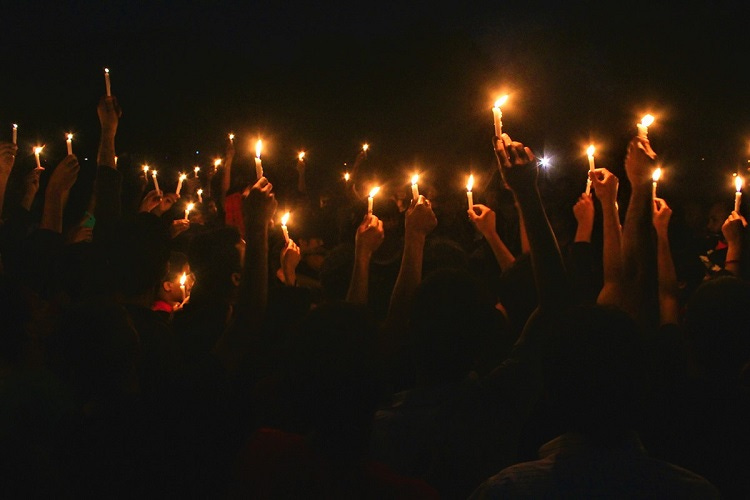
Cold Food Festival
Han Hong

Jie Zitui was a faithful retainer of the Duke of Qin. In extreme adversity, Jie once even cut meat from his own leg to feed his master. But when the Duke failed to reward him for his loyalty, Jie retired into the mountains, and resisted all of the Duke's entreaties to return to court. Finally, in frustration, the Duke set fire to the mountains to smoke Jie out. Jie's body was found clasped tight to a tree. In remorse for his anger, the Duke declared Jie Zitui would be commemorated for three days every spring, days on which no flame may be lit, and all would eat cold food.

On the Day of No Fire,
Flying petals filled the springtime city,
Royal willows leant as the east wind blew.
At sunset from the royal palace, candles
Bore dainty smoke to homes of the noble few.

韩翃  寒食
春城无处不飞花,寒食东风御柳斜。
日暮汉宫传蜡烛,轻烟散入五侯家。
This is a frustrating poem for me as a translator, because it’s a beautiful, bitter, understated, deeply cutting satirical little gem, but there’s no way to convey that without a lot of backstory. I generally like to minimise the footnotes, but they’re absolutely vital here.
So, Cold Food Festival was a Tang Dynasty festival that occured close to what is now Qingming/Clear and Bright Festival, around Easter time. I put the backstory in as a note below the title of the poem. And the point of the festival was that you not only had to eat without cooking; no flames were to be lit whatsoever. That meant no candles in the evening. Unsurprisingly, the rich of Chang’an weren’t willing to put themselves through such terrible deprivation. And there was a solution: you could ask for special dispensation from the emperor, and if he granted it, though you could not light your own fires, he would send you lit candles through the streets.
So for three nights of the year, the circuits of privilege and connection, the connections that set “them” apart from the common herd, were traced out in bright processions leading from the gates of the palace, streaming into mansions of all those shameless enough to shrug off the custom of millennia. The sweet miasma of royal favour, normally so intangible, was highlighted for all to see.
What makes this such a special poem is the way Han hides his devastating critique in the mildest of forms; and transforms the meaning of conventional imagery through its subtext. In a Chang’an spring, there are brilliant flowers everywhere - so why do only some of them receive special favour? And why are they unanchored, flying in air? The willows in the wind are leaning - why are they unable to grow straight? In the second half of the poem, the dainty smoke of the candles, normally a symbol of warmth and civilisation, turns into the reeking breath of vested interests.
Every age has its own unique image of corruption. When I was young in the UK, it was the money stuffed in envelopes of the cash-for-questions scandal. Now, its - well. I couldn’t bear to put up an image of what the corruption of power looks like in 2025.
Here’s Cinix with the reconstructed reading: