
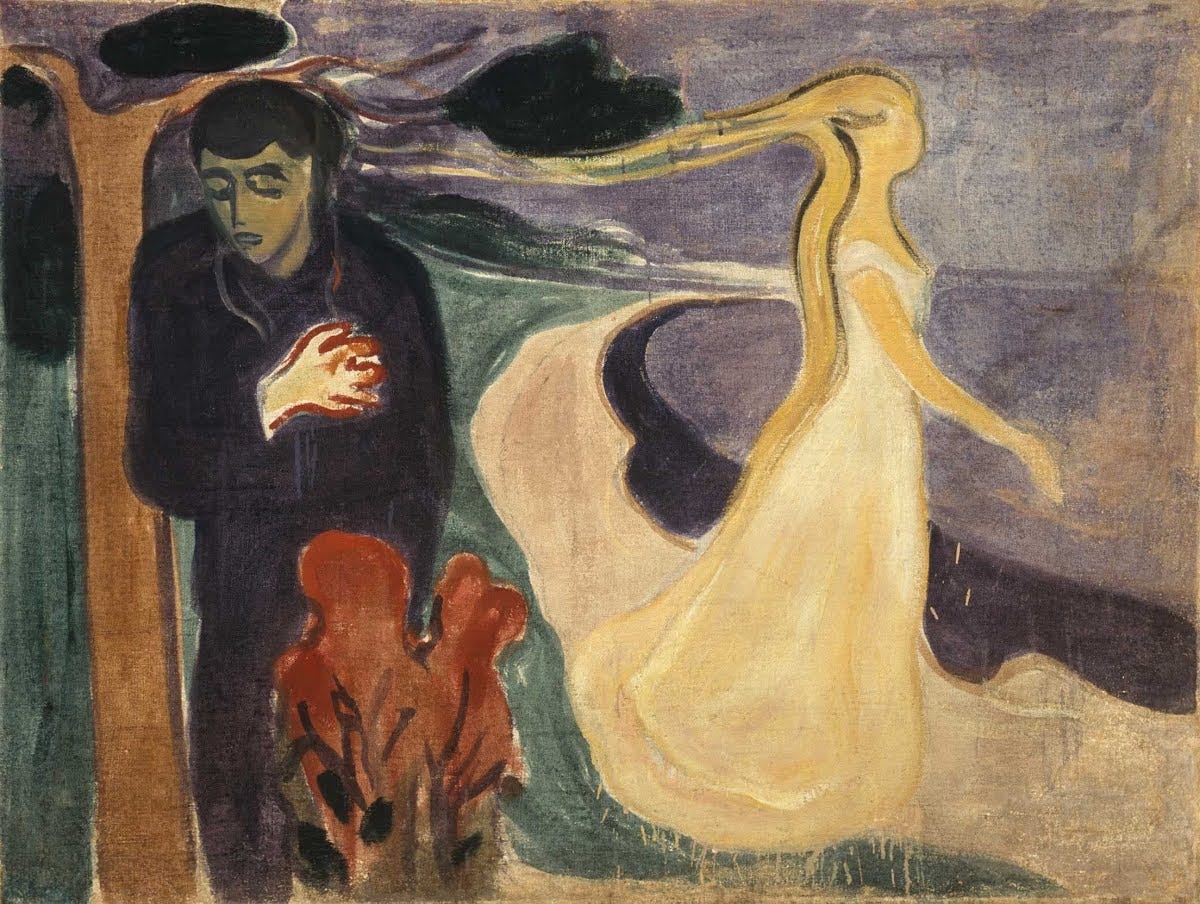
The Song of Eternal Suffering
Bai Juyi

The Lord of the Han lusted after beauty:
The kind of face
You’d give your life for, or your country,

But in all his days
As emperor, he had never found her.
Now, a young maid

Had come of age, deep in some cloister
Of the Yang heirs,
Unseen, as yet, by any worldly suitor.

When the stars
Align and beget the quality of beauty,
It will not lose

Its purpose: the girl was called to do her duty
In the annex
Adjoining to the quarters of His Majesty,

Where she’d perfect
A hundred smiles and backward, come-hither glances,
Demure coquette.

All the rouge and mascara of six palaces
Paled next to her.
She was chosen for one of the coveted places

At the Huaqing spa,
Where bathing in the hot springs would rid
The chill of winter.

Oh, how the beads of water on her skin slid,
Slick as dripping,
How she hung on her attendants’ arms, so languid,

So yielding,
That from this day the grace and favour of the king
Was hers for the getting.

Her face was a flower, her brows the clouds of spring,
And as she stepped,
Pendants gently swayed on a golden hairpin.

On cold nights she slipped
Inside the bridal bed’s lotus-embroidered canopy,
And warmly slept.

They cursed those winter nights for their brevity;
They would not rise.
There was no more dawn court for His Majesty,

Just parties for days,
An unbroken string of feast after feast.
In spring, they’d cruise,

And they used each night to its fullest.
Three thousand women
In his harem; now three thousand passions pressed

Onto one person.
In the evenings, the dressing-room where she prepared
Was rich and golden;

They banqueted in palaces of jade,
And then surrendered
To inebriation and their lush spring mood.

In reward,
Her brothers and sisters were all granted land,
Each one a lord,

Ennobled in her halo of light and his fond
Infatuation.
It affected every parent’s mind:

Instead of a son,
Producing a daughter became each family’s
New ambition.

In her quarters, the Black Stallion galleries,
The penthouse chamber
Stood in the clouds. Fantastical melodies

Reached every corner,
And coalesced in her crooned song
And languorous rumba,

Which the emperor watched all day long—
Until one night
The war drums rumbled in from Yuyang,

With a force that brought
Her Dance of the Rainbow Skirts and Feathered Vest
To a shattered halt.

Above the Wall of Nine Gates, all was dust.
And so they left:
Ten thousand chariots and riders toward the southwest,

With the royal crest
Of kingfisher plumes at the column’s head,
Advancing west,

When, fifty miles from the city, the palace guard
Refused to march
Until the one they blamed was dead.

The perfect arch
Of her eyebrows became a casualty of war,
And no-one would touch

The hairpin carved into a tiny jewel flower
That dropped on the floor,
Or the jade clips or golden peacock feather.

The emperor
Could not save her; his hands covered his face
But his tears

Ran as freely as her blood when he walked away.
The wind sighed
In yellow dust as they climbed the cloud-paved

Cliff-face road
Up Jiange, past Mt Emei, where few travellers dare
To walk or ride,

And their banners were dull in the sun’s watery glare.
They reached the highland
Where the rivers were emerald and the mountains fair,

But the king’s mind
Day and night, was absorbed by his passion
For the love left behind.

When the moon shone on his mountain hold, his expression
Was grief and pain,
In the night rain, the ringing of bells was desolation.

The heavens spun,
Soon it was time to return to his dragon throne,
But when he came

To that place, his heart broke, and he could not go on.
In the earth
At the bottom of Mawei Hill, there was no sign

In the filth
Of where her precious face had met
That needless death.

The lord and ministers leant together and let
Their tears stream,
Then looked to the east, to the city gate,

And trailed home,
Trusting the horses to find their own way.
Chang’an was the same:

Taiye Pool where the waterlilies lie,
And Weiyang Palace
With elegant willows row by row—

But each one traced
The curve of her eyebrows, and every lotus flower
Was her face.

Seeing all of this, of course he shed a tear.
In the spring zephyr,
When peach and plum blooms appear,

In an autumn downpour,
When the leaves of the scholar tree cascade,
He missed her.

In Western and Southern Hall, where he stayed,
The weeds sprang up,
And the red leaves, thick and unswept, heaped

On the palace step;
Grey hairs sprouted on the Pear Garden players,
And the makeup

Of the ladies in the pepper-scented chambers
Would fade and crack.
When the fireflies danced around his old quarters,

He didn’t look;
His lonely, sleepless tallow light
Burned out its wick.

The slow watch drums brought only long night,
Until the stars,
As dawn approached, faded from sight.

Fired in pairs,
The tiles on his roof were now frosted over;
Crystal layers

Settled thick. The kingfisher marriage cover
Was cold as ice,
And would not be shared with any lover.

So death and life
Held them separate for many years,
That great divide;

Never once was her soul able to pierce
Into his dream,
Until a specialist in the Daoist lores,

An adept, came
From Linqiong to the city academy,
Who knew the charm

To summon souls anywhere in eternity.
Because they’d heard
Of the king’s compulsive, endless misery,

They implored
This master to use every ounce of his ability
And search hard.

He rose to heaven, plumbed the earth,
He rode on emptiness.
As fast as lightning bolts, he scoured
All corners in his quest.
He combed the azure firmament
And Springs of Endlessness,
Two vaults whose nebulous expanse
He searched without success.

Until he heard mention
That far out to sea, in the semi-fantastic, there was
A faerie mountain,

Where wrought crystal-chiming spires graze
The shimmering cloud,
And living inside, a host of immortal beauties.

Among that crowd
There was one who went by Ultima True.
And it was said

She had a face like a flower and skin as white as snow—
It could be her!
He went to the western hall of her golden chateau,

Knocked on the jade door,
And bade the little jade girl announce him
To that goddess-courtier.

When she, in her nine-flower canopy, heard of a messenger from
The Emperor of Han,
Her spirit was startled from its dream.

She pulled clothes on,
Pillows pushed aside, rose and rushed here and there,
Throwing open

Her silver-inlaid screen and pearly portiere,
Ran to the door,
With her floral crown as askew as her hair,

Letting the air
Fill the billowing sleeves of her fabulous dress
Just like before,

In the Dance of the Rainbow Skirts and Feathered Vest.
Her face was white,
Pale as jade and paler for her loneliness,

Teary wet,
Like pear blossoms in spring rain.
As she wept,

She fervently thanked her sovereign,
Whose face and voice
Had become dim to her since their separation.

Without the grace
And love she once received in the palace of Zhaoyang,
Even in this paradise

Of Penglai, the days and months dragged long.
When she gazed down
At the human world, she saw nothing:

The city of Chang’an
Was hidden beyond the reach of her vision
In the dust and rain.

Now, all she had to express her emotion
Were old tokens:
An inlaid shell case with a golden hairpin.

She gave these items
To the monk, but only half of each:
One of the wings

Of the hairpin—she snapped off the other branch—
And one side
Of the shell case, which she broke at the hinge.

She gave her word
That her heart remained as true as these,
The shell and gold,

And that they would meet up in the skies
If not on earth.
But before they said their goodbyes,

She mentioned an oath
That came from a private memory:
On the seventh

Day of the seventh month, at the Hall of Longevity,
The words we have
Murmured together in the night, intimately:

That up above
We’d fly as lovebirds, feather to wingtip feather;
That we would live
As inosculated trees, branches twined together.

In this universe,
Everything has its end; nothing lasts forever,
Except our hurt,
Which lengthens and will lengthen without measure.
Imposing in length, but a poem that earns its wordcount.
The primary reading of this poem is of course a meditation on the nature of human suffering: how it can strike even the greatest of us; and how there is no ultimate escape.
The other important content is the implied criticism of Xuanzong. He could have controlled himself better, and perhaps could have saved his empire, and saved himself much pain.
But I wonder if a third reading, perhaps even bleaker, is possible. One of the great tropes of Tang poetry is that the woman in a relationship often represents the poet in his relationship with the emperor. A classic example is this series from Zhang Jiuling. This interpretation is not usually applied to the Song of Eternal Suffering because the partners in this poem are real, identifiable individuals, not anonymous stand-ins. But I think that this interpretation still makes sense.
If Yang represents Bai Juyi, or officialdom more generally, then we see officials performing for the pleasure of the emperor; then, when disaster strikes, the emperor casts them off. After the rebellion is suppressed, even though the emperor returns to the centre of his nation, he no longer has the relationship with his lover/state ministers; and its absence is felt like a pain.
This would be a legitimate reading of the situation in the second half of the Tang Dynasty. The rebellion of An Lushan caused severe disruption in civil society and the civilian bureaucracy; more power shifted to the military; and local militias often had weaker links to the centre, and were sometimes fairly autonomous in the way they operated. The close love between the emperor and his state was gone. In this reading, Bai sees the faithful officials as waiting in the wings, still pining for that close relationship they had before, but recognising that the political situation has changed. This pain is forever.
Lord of the Han: Despite being explicitly about Yang Yuhuan (Yang Guifei), consort of the Tang emperor Xuanzong, the poem still maintains the convention of writing about a Han Dynasty emperor as a stand-in for a Tang emperor.
Young maid of the Yang heirs: Yang Yuhuan, birth name unknown, also known as Yang Guifei (a title meaning consort Yang).
Six palaces: The inner quarters in the Chang’an forbidden city.
Huaqing: Hot springs outside the city, where the emperor would travel for a winter break.
Dawn court: One of the emperor’s key duties, the largest conference with his gathered officials, held at dawn each day. The emperor’s willingness to attend dawn court was seen as a key indicator of his dedication to the job, and his worth as an emperor.
Black Stallion galleries: The queen’s hall was built on a hill named “Black Horse,” and took its name from the hill.
Yuyang: One of the key mountain passes between the central plain, where Chang’an stood, and the northwest. An Lushan’s rebel army fought through this chokepoint on its way to attacking the capital.
Dance of the Rainbow Skirts and Feathered Vest: A dance apparently invented by Yang Yuhuan, involving bright costumes and the spinning dance moves and flying skirts that were fashionable at the time.
Wall of Nine Gates: The wall of the Tang palace.
The one they blamed: The failure to defend the city was blamed on the chancellor, Yang Guozhong; Yang Yuhuan, who was his cousin, was blamed for getting him his position.
Jiange: A range of steep hills on the route towards Sichuan. The road passed along narrow boardwalks built into the cliff face.
Highland: Sichuan.
Mawei Hill: The site of Yang Yuhuan’s execution.
Pear Garden players: A conservatory founded by Xuanzong to train the players who would accompany his harem singers.
Pepper-scented chambers: The walls of the women’s quarters were decorated with a plaster that had peppercorns mixed in, so that the chambers had a permanent exotic aroma.
The tiles on his roof: Roof tiles were placed in the kiln in pairs, so they became a symbol of romantic love.
Ultima True: The name Yang Yuhuan had adopted when she entered a monastery. (She was originally married to Xuanzong’s son. When the emperor saw her and desired her, he had her first take holy orders as a reason to leave her the prince. Then, after what was considered a decent interview, the emperor brought her into his own harem.)
Palace of Zhaoyang: The queen’s palace in the Tang court.
So very powerful and moving when put altogether. A great translation, Phil.