Chill out
Wang Wei offers reasons to relax

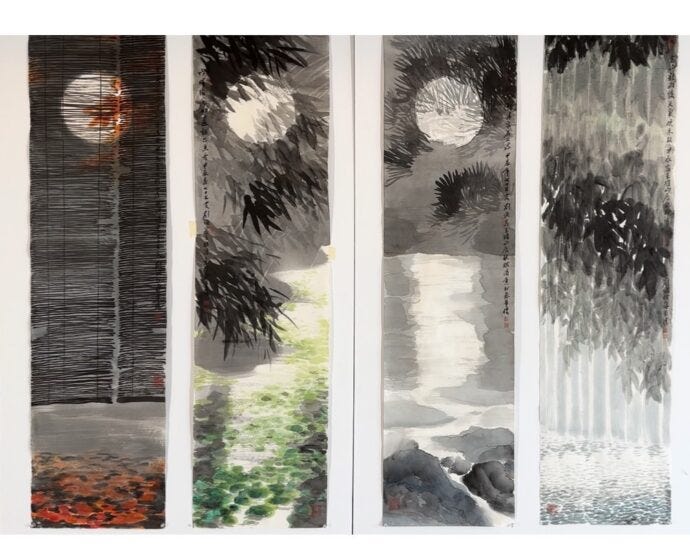
Autumn Evening at my House in the Hills
Wang Wei

Secluded hills, fresh from rain,
At dusk feel autumn air again,
Across the stones, between the pines,
A clear spring flows, the bright moon shines.
Each bamboo bustle’s a washer maid,
There’s fisherfolk where lotus swayed.
If springtime flowers may drop at will,
Prince Wang may linger on this hill.

王维  山居秋暝
空山新雨后,天气晚来秋。
明月松间照,清泉石上流。
竹喧归浣女,莲动下渔舟。
随意春芳歇,王孙自可留。
Sometimes, I’d love to be American. There are lots of Americanisms that I like, and when you’re translating Chinese poems, the flexibility of using “fall” for autumn would be extremely helpful. Line 2 really wants to be something like “The evening skies hold fall again.” But I’m not American, and when I try to write in American it just sounds silly, so we’re stuck with using autumn.
In this poem Wang Wei engages in a trick that he rather likes: he declares the mountains to be secluded (literally “empty”), and then populates them with lots of imaginary countryfolk. It betrays a rather snooty attitude towards the farmers who did live in the area. But the effect that Wang is going for is to transport us to the semi-real, a poet’s imagine rural idyll, rather than any actual existing hill.
On this hill, there may or may not be real people. But the fey creatures of Wang’s world are multitudinous. First, whenever the bamboo rustles, it’s most likely a comely farm girl bringing home the laundry from her riverside washing spot. She’s definitely pretty, because this is an echo of history’s most famous washer-girl, the nation-destroying beauty Xi Shi, who was discovered by the kings “talent” scouts as she washed clothes by a stream. Then, whenever the lotus leaves on the pond waver, it’s surely because some mysterious and handsome fisherman is passing by underneath their cover (picture those lotus leaves that stand proud of the surface, rather than the water lily leaves that lie flat on the surface). There’s no specific story attached to the fishermen, so far as I know. They’re just the kind of hale folk you’d like to spend your afternoons with, dozing on a rock by the river.
At the end of the poem, there’s a bit of a joke. Wang is both Wang Wei’s surname, and the Chinese word for king. So the word used in the original, “grandson of Wang” is a word for a prince - since generalised to be a respectful term for any young noble - and also a reference to himself. He is either persuading a guest that it would be fine to stay for a few more days in this refuge from city life; or asserting his own right to take more time off before he heads back to it.
Here’s the reconstructed Tang dialect reading by Cinix:
I very much appreciate your posts and love reading your translations. They're like the "refuge from city life" you speak about above - albeit for a few moments, rather than a few days! Also love the images you find.